
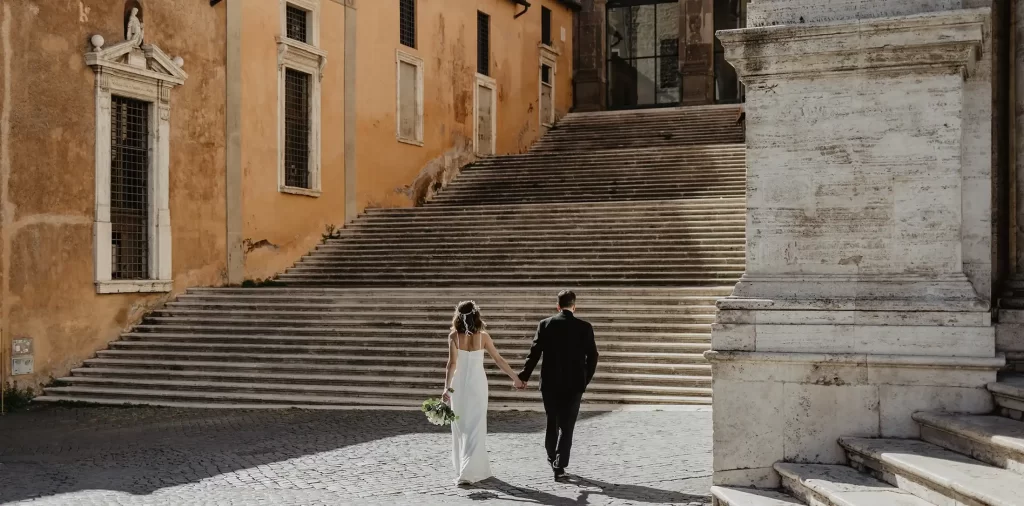
Rome is one of those cities that does something unusual to people in front of a camera, it relaxes them. There’s so much to look at, so much texture and light and history around every corner, that most couples forget about the camera entirely within the first twenty minutes. That’s exactly what I’m counting on.
I photograph engagement sessions and pre-wedding shoots across Rome regularly, for couples who are getting married in the city, and for couples who are marrying elsewhere in Italy and want to use a day in Rome to get comfortable with me before the wedding. Both are good reasons. Here’s where I take people, and why the session itself matters as much as the location.
Read also: Most iconic couple photoshoots destinations
Why do a pre-wedding shoot in Rome before your wedding day?
The most practical reason is also the least romantic one: it’s a rehearsal. Most people have never been photographed professionally for more than a passport photo or a stiff family portrait. An engagement session in Rome gives you an hour or two to work out how to move, where to look, what to do with your hands, all the things that feel awkward on a wedding day when the stakes are higher and the time is shorter. I’ve written more about why a pre-wedding shoot in Italy is worth it if you want to understand the full picture before deciding.
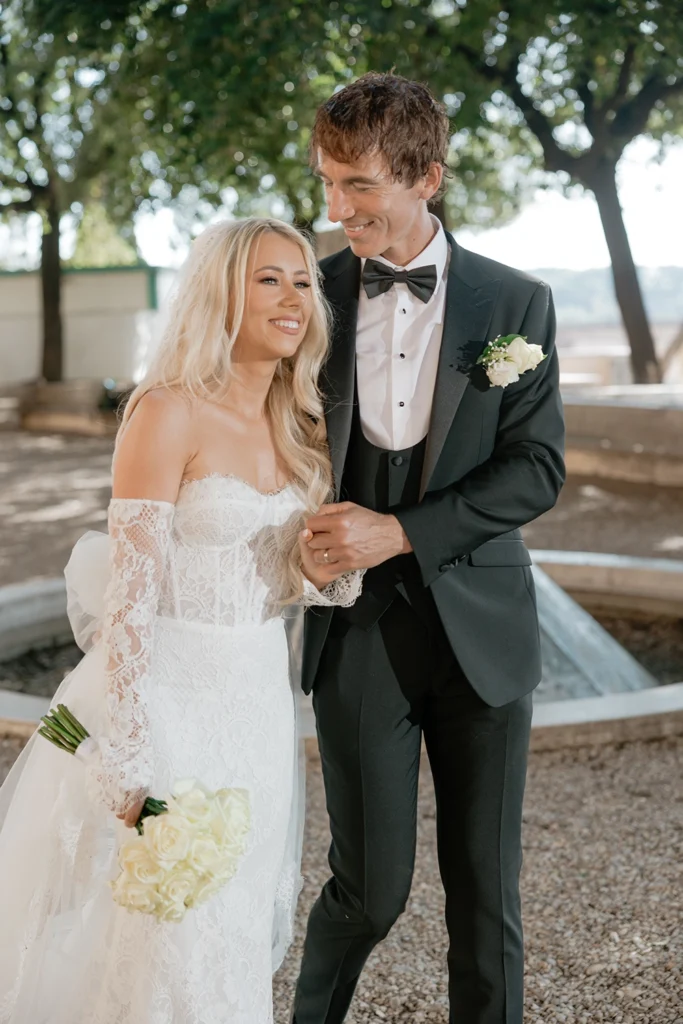
By the end of a session in Rome, something shifts. I see it every time. Couples who arrived nervous and over-aware of the camera leave laughing, at ease, and often surprised by how natural the photos feel. That ease carries directly into the wedding day. There’s also a more personal reason. Your engagement is its own moment, distinct from the wedding, worth documenting on its own terms. Rome, with its particular combination of ancient grandeur and intimate neighbourhood life, gives that moment a setting unlike anywhere else.

Read also: The elegance of Italian wedding fashion
The best spots for an engagement shoot in Rome
Rome has no shortage of photogenic locations, but not all of them work equally well for couple photography. These are the places I return to most often, and what makes each one distinctive from a photographer’s perspective.
Trastevere
Trastevere is my first recommendation for most couples, especially those who want something that feels intimate rather than monumental. The neighbourhood sits on the west bank of the Tiber, just south of the Vatican, and its narrow streets, ochre-coloured walls, and ivy-covered doorways create a setting that is unmistakably Roman without being overwhelmed by tourists, particularly in the early morning or early evening.
The light in Trastevere in the late afternoon is exceptional. It comes in low and warm through the gaps between buildings, hitting the stone at an angle that turns everything golden. Piazza di Santa Maria in Trastevere, with its mosaic-fronted basilica and central fountain, works beautifully for wider shots. The surrounding streets are better for something more private and close.
The Colosseum and the Imperial Forums
The Colosseum is Rome’s most iconic landmark, and photographing couples here requires timing more than anything else. Early morning — before 8am — is when the Colosseum belongs to you. The light comes in from the east, the crowds haven’t arrived, and the scale of the structure is at its most dramatic.
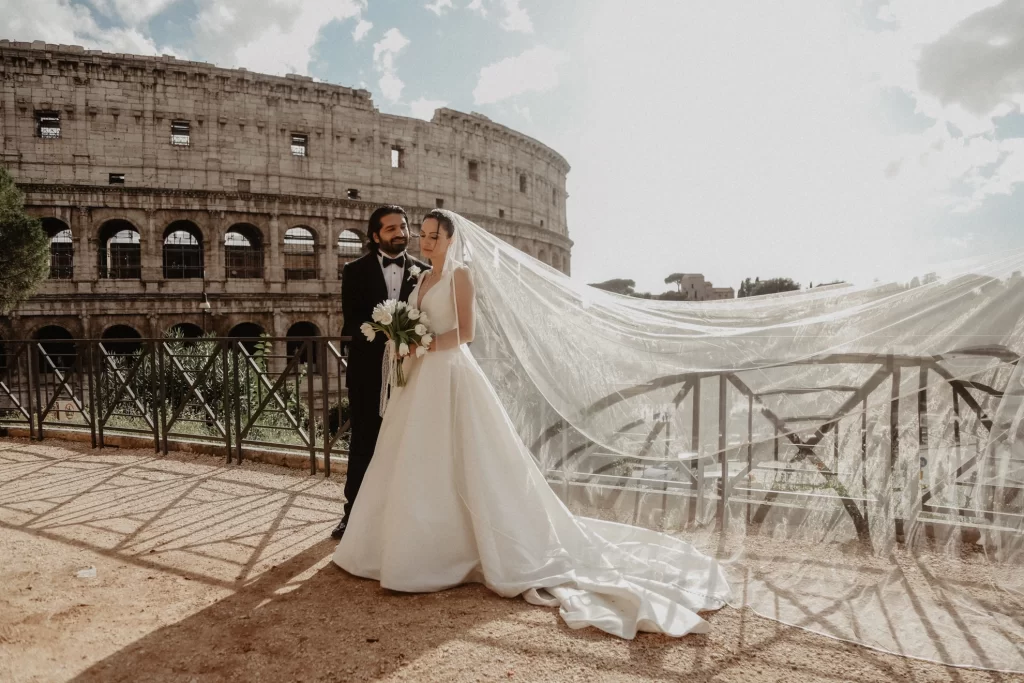
From Colle Oppio Park, slightly elevated above the Colosseum, you get a panoramic perspective that places the couple within the landscape rather than just in front of it. The Via dei Fori Imperiali, running alongside the Imperial Forums, offers a long straight axis that works well for walking shots. The Roman Forum itself, visible from the Palatine Hill, adds an archaeological depth to the background that no other city in the world can replicate.
The Pantheon and Piazza della Rotonda
The Pantheon, built in 27 BC, rebuilt under Hadrian in the 2nd century AD, and still standing intact, is one of the most extraordinary buildings in existence. The Piazza della Rotonda in front of it is compact and well-proportioned, which makes it easier to frame than larger open squares.
I prefer shooting here in overcast light, which softens the contrast and brings out the detail in the stone facade. Early morning works well too, before the market stalls set up and the square fills. The interior of the Pantheon, with its oculus open to the sky, offers a brief window of extraordinary light around midday, the shaft of sunlight that falls through the opening changes angle and intensity as the minutes pass.
The Spanish Steps and Trinità dei Monti
The Spanish Steps, 135 steps connecting the Piazza di Spagna below to the Trinità dei Monti church above, are at their best photographically in the early morning, before the vendors and tourists arrive. The view from the top, across the rooftops of Rome, is one of the city’s finest. The Barcaccia fountain at the base of the steps, designed by Pietro Bernini, adds foreground interest to shots looking upward. The church itself, with its twin bell towers and travertine facade, is worth the climb for portraits.
Villa Borghese and the Pincio Terrace
Villa Borghese is Rome’s largest public park, a landscape of gardens, fountains, and umbrella pines that offers a quieter, greener side of the city. The Pincio Terrace, at the park’s western edge, has one of Rome’s best panoramic views: the dome of St. Peter’s Basilica in the middle distance, the rooftops of the centro storico, and the hills beyond.

The park works well for couples who want something less urban, space to walk, sit, and exist together without the pressure of a specific landmark. It’s also one of the few places in central Rome where you can shoot at midday without fighting harsh direct light, because the tree canopy diffuses everything.
The Trevi Fountain
The Trevi Fountain is Rome’s most visited monument, which makes timing everything. The only realistic window for photography without crowds is between 5.30 and 7am. At that hour, the travertine catches the first light beautifully, the water sounds are audible rather than drowned out by noise, and the scale of Nicola Salvi’s Baroque masterpiece is properly apparent.
I don’t recommend the Trevi Fountain as the main body of a session, the logistics are too dependent on timing. But as a single stop within a broader morning shoot, it’s hard to argue with.
The Aqueduct Park (Parco degli Acquedotti)
Less known than the landmarks above, the Parco degli Acquedotti on Rome’s south-eastern outskirts is one of my favourite locations for a different kind of Rome portrait. The remains of two ancient Roman aqueducts — the Aqua Claudia and the Anio Novus — run across a wide open meadow, creating a backdrop that is simultaneously ancient and cinematic. If you’re looking for something completely off the tourist trail, this is where I’d take you. I’ve written about some of Rome’s secret spots for couple shoots if you want to explore further options beyond the well-known landmarks.
The park has almost no tourist presence and extraordinary open light. In late afternoon, with the aqueduct arches casting long shadows across the grass and the city skyline visible in the distance, it produces images that look unlike anything you’d get in the centro storico.

Terrazza Caffarelli: Views of the Roman roofs
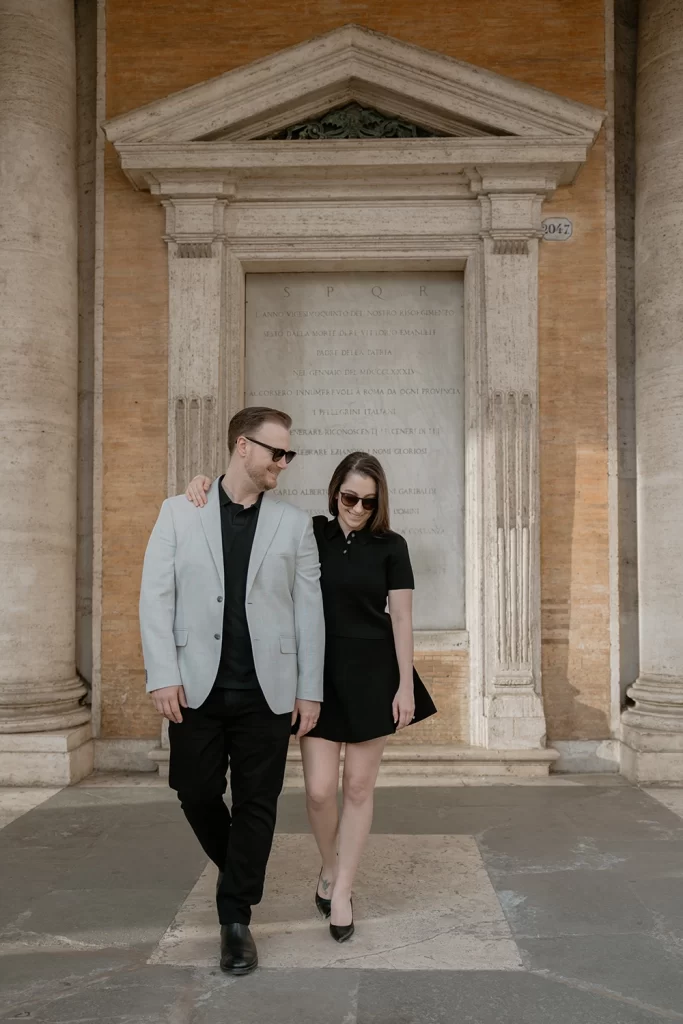
The Terrazza Caffarelli is a beautiful and romantic location in Rome that is perfect for shooting couples. Located on the Capitoline Hill, the terrace offers stunning views of the city and a serene atmosphere that is perfect for romantic photography.
The terrace is named after the famous architect, Carlo Fontana, who designed the Palazzo dei Conservatori, which is located adjacent to the terrace. The Palazzo is a beautiful building that houses a collection of ancient Roman artifacts, making it a popular destination for tourists and history buffs.
One of the main attractions of the Terrazza Caffarelli is its panoramic views of Rome. From the top of the terrace, you can see the entire cityscape, including the Roman Forum, the Colosseum, and the Tiber River. The views are especially beautiful during sunset when the sky is painted in warm hues of orange and pink.
For couples looking to capture their love in a beautiful and romantic location, the Terrazza Caffarelli is the perfect spot. The terrace is quiet and peaceful, offering a serene backdrop for intimate couple shots. The ancient Roman architecture and beautiful views also add a unique and romantic touch to any photo..
Whether you’re a professional photographer or just looking to capture some memories with your loved one, the Terrazza Caffarelli is a beautiful and romantic location that is perfect for couples photography. With its stunning views and peaceful atmosphere, it’s a spot that you won’t want to miss on your next visit to Rome.
Read also: The best Spots in Florence for Couple Shoots
How I work during an engagement session in Rome
Most couples I photograph arrive at the meeting point slightly nervous. They’re not sure how much to pose, whether to look at the camera or at each other, what to do when I’m not directing them. This is completely normal and I expect it.
I don’t work with rigid poses or structured sequences. We walk, we talk, we find places to sit or stand that feel natural rather than arranged. I give direction when it’s useful — a slight turn of the shoulder, moving into better light — but mostly I’m watching for the moments that happen between the directed ones. Those are almost always the best images.
By the second half of the session, most couples have stopped thinking about the camera entirely. The conversation flows, they joke with each other, they forget I’m there. That’s the point I’m working toward from the moment we meet.
Sessions typically last 1.5 to 2 hours. We usually move through two or three locations depending on pace and light. I work alone — no assistants, no lighting equipment. Just a camera, available light, and as little disruption to the moment as possible.
If you’re getting married in Rome, you might also want to read about the best venues for a wedding in Rome and what wedding photography in Rome typically costs — both useful to have alongside this when you’re planning.
Practical notes for a Rome engagement session
Best time of year: April, May, September and October offer the most consistent light and manageable temperatures. According to Rome’s official tourism statistics, these months see significantly fewer visitors than summer, which makes early morning shoots at iconic landmarks far more manageable. June to August can work but the heat mid-day is significant — early mornings become essential.
Best time of day: Golden hour, one hour before sunset, is the most flattering light in Rome and works for almost every location. Early morning before 8am is the only viable option for the Trevi Fountain and the Colosseum area.
What to wear: Rome’s streets are uneven, cobblestones, steps, sloping piazzas. Comfortable shoes matter more than most couples expect. For colours, muted tones work best; they don’t compete with the ochre and terracotta of the buildings. Avoid perfectly matching outfits; coordination works better than uniformity.
Getting around: Rome’s centro storico is largely pedestrian, which works in our favour. Most of the locations above are within walking distance of each other. For the Aqueduct Park, we’d travel by taxi or rental car.
Planning a pre-wedding shoot or engagement session in Rome?
If you’re getting married in Rome or anywhere in Italy and would like to add a session in the city, I’d be glad to hear about your plans. Rome is where I’m based, and it’s a place I know in the kind of detail that only comes from photographing it across every season and every hour of the day. You can also browse my real weddings to see how Rome looks across different seasons and light conditions before reaching out.
→ Get in touch to check availability → See my portfolio
Written by Cristiana Fiorini, destination wedding photographer based in Italy, working across Italy.


