
Florence is one of those cities that does something unusual to people in front of a camera, it relaxes them. There is so much to look at, so much history pressing in from every direction, that self-consciousness tends to dissolve. I have photographed couples here many times, for engagement shoots and pre-wedding sessions across the city, and what strikes me every time is how naturally people inhabit the space. Florence does not feel like a backdrop. It feels like a place where love stories have always been told.
This guide covers what I have learned about photographing in Florence; the streets, the light, the timing, and the venues, for couples planning a wedding or engagement session here. If you are considering Florence for your wedding and want to understand how photography works in this city specifically, this is where to start.

Florence as a Photography Location — What Makes It Different
Florence is not Rome. Where Rome overwhelms with scale and drama, Florence works through intimacy and detail. The city is compact enough to move between locations quickly, but dense enough with visual richness that you never run out of interesting ground.
The light in Florence is particular. Because the city sits in a bowl surrounded by hills, the light bounces differently than on the coast or in open countryside. In the late afternoon, when the sun drops toward the Oltrarno hills, it catches the warm stone of the buildings along the Arno and turns everything amber. This is not the sharp golden hour you get in Tuscany’s open fields, it is softer, more diffused, more urban. It suits a documentary approach very well.
The best time to photograph in Florence is early morning before nine, and late afternoon from five onward. Between these windows the city is crowded, the light is harsh, and the backgrounds become cluttered. Plan your photography around these hours and Florence rewards you generously. Outside them, it requires more work.
Read also: The best spots in Florence for couple shoots

The Best Locations in Florence for Wedding Photography
Oltrarno
The south bank of the Arno is the most consistently beautiful part of the city for photography. The streets are narrower, less touristy, and the architecture has a warmth and texture that the north bank’s more famous streets often lack. The area around Santo Spirito, with its wide piazza and ochre facades, works particularly well in the early morning when the light is still cool and the square is quiet. The side streets between Ponte Vecchio and Ponte Santa Trinita offer extraordinary light in the hour before sunset, the buildings face west and catch the last warmth of the day directly.
Bardini Gardens
The Bardini Gardens on the Oltrarno hill are consistently underused by wedding photographers, which makes them one of my preferred locations in the city. They offer a terraced view over Florence’s rooftops that is more intimate than Piazzale Michelangelo, less famous, less crowded, and with a perspective that includes the city’s texture rather than just its skyline. The wisteria pergola in April and May is one of the most beautiful things in Florence for photography. If your wedding falls in spring, it is worth planning an engagement session specifically around this.
Piazzale Michelangelo
The obvious choice, and obvious for good reason. The panoramic view of the city from the hill above the Arno is genuinely extraordinary. The challenge is timing, during the day it is overwhelmed with tour buses and the light is flat. At sunrise, before seven in the morning, it is empty and the city below is lit from the east with a clarity that is hard to find anywhere else in Florence. If you are willing to start early, Piazzale Michelangelo rewards that effort with images that are difficult to replicate anywhere else in the city.
Ponte Vecchio and the Arno
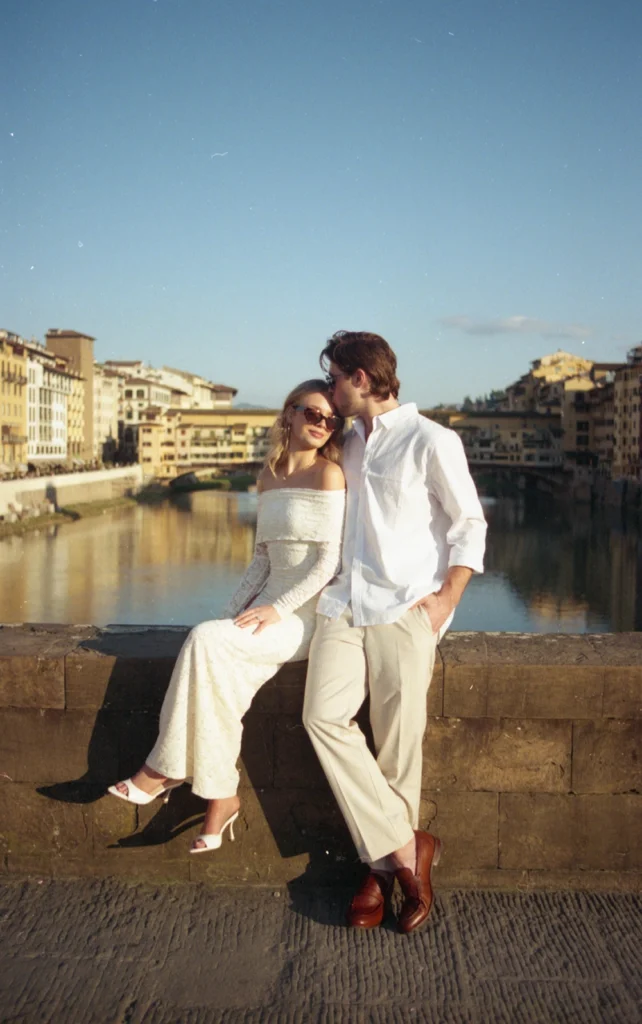
The bridges over the Arno offer some of the most compositionally interesting backgrounds in Florence, the city reflected in the water, the bridges framing each other in the distance, the particular quality of light on the river in the late afternoon. Ponte Vecchio itself is almost impossible to photograph cleanly during the day, but the bridges on either side, Ponte Santa Trinita and Ponte alle Grazie, offer clean sightlines with Ponte Vecchio in the background. Early morning and dusk are the only times that work here.
The Historic Streets of the Centre
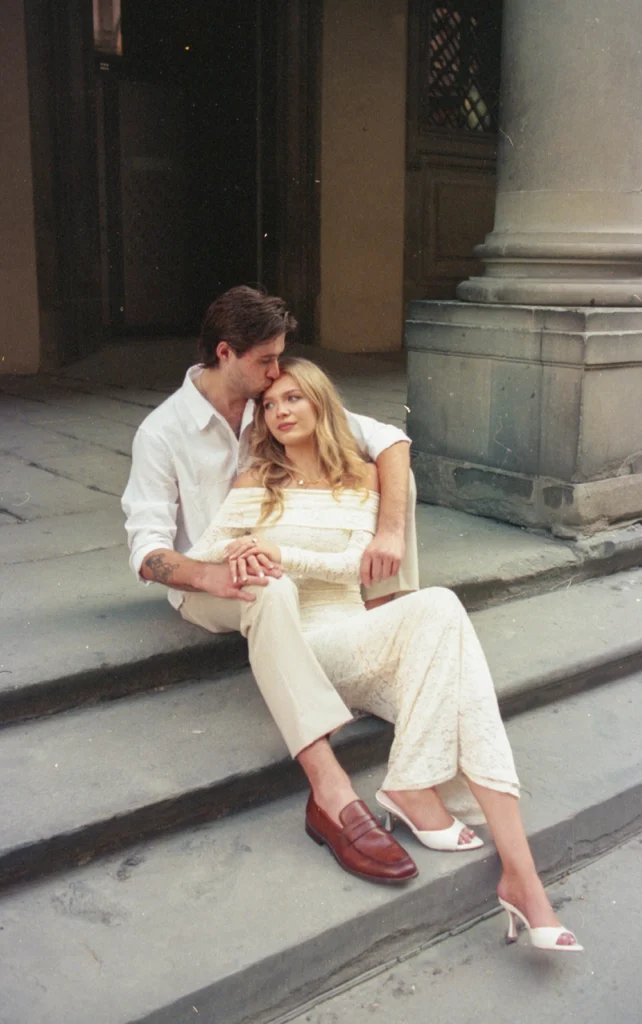
The streets around Via dei Servi, Via Ghibellina, and the area between the Duomo and Santa Croce offer extraordinary incidental backdrops; doorways, arches, courtyards, light falling through narrow gaps between buildings. These work best for candid and documentary work, where the couple is moving rather than posed. The Duomo itself is difficult to use well, it is simply too large to frame with people in a natural way, but the streets around it, and especially the view from the steps of Santa Croce looking across the piazza, offer something more manageable and often more interesting.
Villa Cora — A Venue I Know Well
Villa Cora is a 19th-century neoclassical villa on the Oltrarno hill, between the Boboli Gardens and Piazzale Michelangelo. I have photographed here and what stays with me is the quality of the interiors; high ceilings, frescoed walls, a grand staircase that catches light from above in a way that makes portraits effortless. The villa does not require you to work hard to find interesting compositions. The spaces are so considered that you only need to observe and wait.
The garden terrace overlooking the city is the obvious centrepiece for ceremony and couple portraits. It faces north across Florence, which means it catches beautiful reflected light rather than direct sun, this makes it unusually forgiving at almost any hour of the day. The view from the terrace, with the Duomo and the hills beyond, is one of the most complete and legible panoramas in the city.
What I would tell couples considering Villa Cora is this: use the interiors as much as the garden. The temptation is to stay outside for the views, but the rooms inside, the frescoed salons, the library, the corridors with their arched windows — offer a quality of light and a sense of history that the garden cannot replicate. Some of my favourite images from Villa Cora have been taken inside, where the architecture does the framing and the light is extraordinary.
Best season for Villa Cora: April, May, September and October. The summer light on the terrace can be strong in July and August, manageable but requiring more careful planning around timing.

Other Notable Florence Venues
Florence has a strong selection of wedding venues beyond Villa Cora. Castello di Vincigliata, a medieval castle on the hills above Fiesole, is one of the most dramatic settings in the Florentine area, a restored fortress with battlements, a courtyard, and views over the city that are particularly striking in the late afternoon light. Villa Medicea di Lilliano, a working wine estate in the Chianti hills just outside the city, offers a more rural Tuscan atmosphere while remaining close enough to Florence for guests arriving by air. The Boboli Gardens, managed by the Uffizi, occasionally permit private events and offer an extraordinary setting of formal Italian garden design behind the Pitti Palace.
Each of these venues has its own photographic logic and its own logistical requirements. If you are considering any of them, it is worth discussing with your photographer specifically how they approach that space, the best positions, the best timing, the permits required.
Practical Advice for Planning Wedding Photography in Florence
Permits. Florence’s historic centre is a UNESCO World Heritage Site and some locations require permits for professional photography. Certain churches have strict rules about photographers during ceremonies; flash restrictions, positioning limitations, and in some cases full prohibition of photography during the service. A photographer based in Italy will know which locations require advance coordination and can help you navigate this before the day.
Traffic and logistics. The historic centre has significant restrictions on vehicle access. If your venue is within the ZTL zone, coordinate carefully with your photographer on how and when they can move between locations. This is not a problem, it is just something that requires advance planning.
Season. Florence is beautiful in every season but the photographic character of the city changes significantly. Spring is the most immediately beautiful; the wisteria, the light, the green hills visible from every rooftop. Autumn is warmer in atmosphere and often clearer in light. Summer is hot and crowded but the long evenings give you extraordinary golden hour windows. Winter is quiet and intimate, with a quality of light that is soft and diffused throughout the day.


Timing. Florence rewards early risers and late stayers. If your wedding day schedule allows for a couple portrait session at either end of the day, that is where you will get the most from the city’s light. If the reception keeps you inside until late, consider a short morning session the day before or an engagement shoot on arrival.
Read also: How to create a seamless photography timeline for your wedding day
Frequently Asked Questions
What time should you photograph at Piazzale Michelangelo to avoid crowds?
Before seven in the morning is the only window when the square is genuinely empty. Tourist traffic starts around nine and does not stop until after sunset. If your schedule allows, a sunrise session at Piazzale Michelangelo with the city lit from the east produces images that are impossible to achieve at any other time of day.
Is Villa Cora open for weddings year-round?
Yes, Villa Cora hosts weddings throughout the year. The most requested months are May, June, September and October. The panoramic terrace works well in all seasons because it receives reflected rather than direct light, making it photographically generous even during the middle of the day.


Can you have wedding photos taken in the Boboli Gardens?
The Boboli Gardens are managed by the Uffizi and occasionally permit private events, but they require specific authorisations and a formal application process well in advance. The Bardini Gardens, adjacent and less well known, offer a photographically extraordinary alternative with less bureaucracy and significantly fewer crowds.
What are the photography restrictions in Florence’s churches?
Every church has its own rules. In many of Florence’s historic churches flash is prohibited during the ceremony, and in some the photographer can only position themselves in designated areas. Santa Croce, Santa Maria Novella and the Duomo each have specific protocols that need to be agreed in advance with the church administration. A photographer who works regularly in Florence will know these restrictions and can coordinate in advance to avoid surprises on the wedding day.
When does the wisteria bloom at the Bardini Gardens?
Typically between late April and early May, with variations of a week or two depending on the year. The wisteria pergola at the Bardini Gardens is one of the most beautiful photographic subjects in Florence in spring. If your wedding falls in this period, it is worth planning a session specifically around this window.
Browse my portfolio and real weddings to see how I work, then reach out if what you see feels right.
Written by Cristiana Fiorini, destination wedding photographer based in Italy, working across Italy.


