
Italy has more beautiful wedding venues than any other country in the world. That’s not a marketing line, it’s simply true, and after years of photographing weddings from Lake Como to the Amalfi Coast, from the hills of Tuscany to the streets of Rome, I still find new places that take my breath away.
But beauty alone doesn’t make a venue work photographically. Light matters. Space matters. The relationship between the architecture and the landscape matters. A venue that looks extraordinary in a brochure can be genuinely difficult to shoot in and a venue that seems understated on paper can produce the most extraordinary images of a career.
This is my list. Not a ranking, and not a list of the most expensive or the most famous, but the eight venues across Italy that I think offer the most for couples who care deeply about their photographs. If you’re still in the early stages of planning and haven’t chosen a region yet, my guide to destination wedding photography in Italy covers the broader picture before you dive into specific venues.


1. Villa del Balbianello, Lake Como (Lenno, Lombardy)
Villa del Balbianello is one of the few venues in Italy that genuinely exceeds expectations in person. I’ve photographed here and the experience stays with you, not because of any single element, but because of how everything works together: the terraced gardens dropping toward the lake, the loggia with its carved stone columns, the particular quality of Como light in the afternoon that turns the water silver and the stone warm simultaneously.
What makes it exceptional photographically is the layering. You are never shooting against a flat background. There is always depth — water behind stone, garden behind couple, mountain behind sky. The loggia, which faces west, catches the late afternoon light in a way that requires almost no intervention from a photographer. The light does the work.
Logistically, Balbianello is a protected property managed by the FAI, the Fondo Ambiente Italiano, the Italian National Trust, which means access is carefully controlled and the grounds are always immaculate. Permits are required for weddings and must be arranged well in advance. The venue is reached by boat from Lenno or Sala Comacina, which adds a cinematic arrival that I’ve never seen fail to move a couple.
Best season: May, June, and September. The summer light is strong but manageable with the shade the gardens provide. Autumn brings mist on the lake that creates extraordinary atmosphere.
Read more: My full guide to photographing at Villa Balbianello

2. Villa Aurelia, Rome (Gianicolo Hill, Rome)
Villa Aurelia sits on the Gianicolo — the Janiculum Hill — in one of Rome’s most quietly prestigious neighbourhoods, and it offers something genuinely rare in the city: a panoramic terrace with an unobstructed view across the entire centro storico, from the dome of St. Peter’s to the Vittoriano and beyond.
I’ve photographed weddings here and what strikes me every time is the quality of the evening light. Because the terrace faces east, it catches the last warm light of the day reflecting off the city below rather than direct sunlight, which means the golden hour here is softer and longer than almost anywhere else in Rome. The couple is lit from below and behind by a city that is itself glowing.
The villa itself, a 17th-century cardinal’s residence, now managed by the American Academy in Rome — has interiors that are elegant without being overwhelming. High ceilings, terracotta floors, frescoed walls that have aged into something more interesting than anything a decorator could produce deliberately. It photographs best in late afternoon and early evening, when the interior and exterior light balance naturally without flash.
Best season: April through October. September and October are my personal preference, the city light in autumn has a clarity that summer haze often obscures.
Read more: My full Rome venue guide

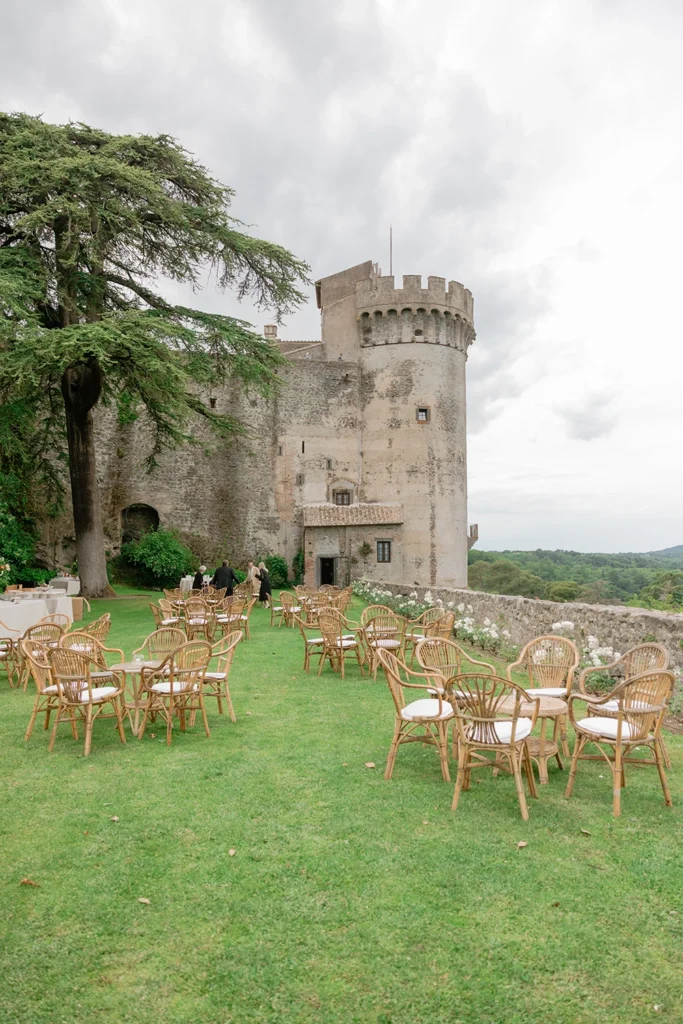
3. Castello Odescalchi, Bracciano (Lazio)
Forty minutes north of Rome on the shores of Lake Bracciano, Castello Odescalchi is one of the most complete and best-preserved Renaissance fortresses in Italy. Built in the 15th century by the Orsini family and later acquired by the Odescalchi, one of Rome’s great noble families, the castle has hosted some of the most celebrated weddings in living memory.
What makes it extraordinary is the combination of scale and authenticity. This is not a restored venue dressed to look historic — it is a living historic building, with original frescoes, period furnishings, armour collections, and architectural details that have survived intact for six centuries. The great hall, the courtyard, the battlements overlooking the lake, each space has its own character and its own photographic logic.
The lake setting adds a dimension that few Lazio venues can match. Lake Bracciano is a volcanic crater lake; deep, still, and a particular shade of blue-green that photographs with extraordinary richness. Ceremonies on the castle ramparts, with the lake stretching to the horizon below, produce images that are unlike anything available closer to the city.
Practical note: Castello Odescalchi is a private residence and events venue with full hospitality services. Advance planning of 12–18 months is recommended for peak season dates.
Best season: May, June, September.
4. Palazzo Avino, Ravello (Amalfi Coast)
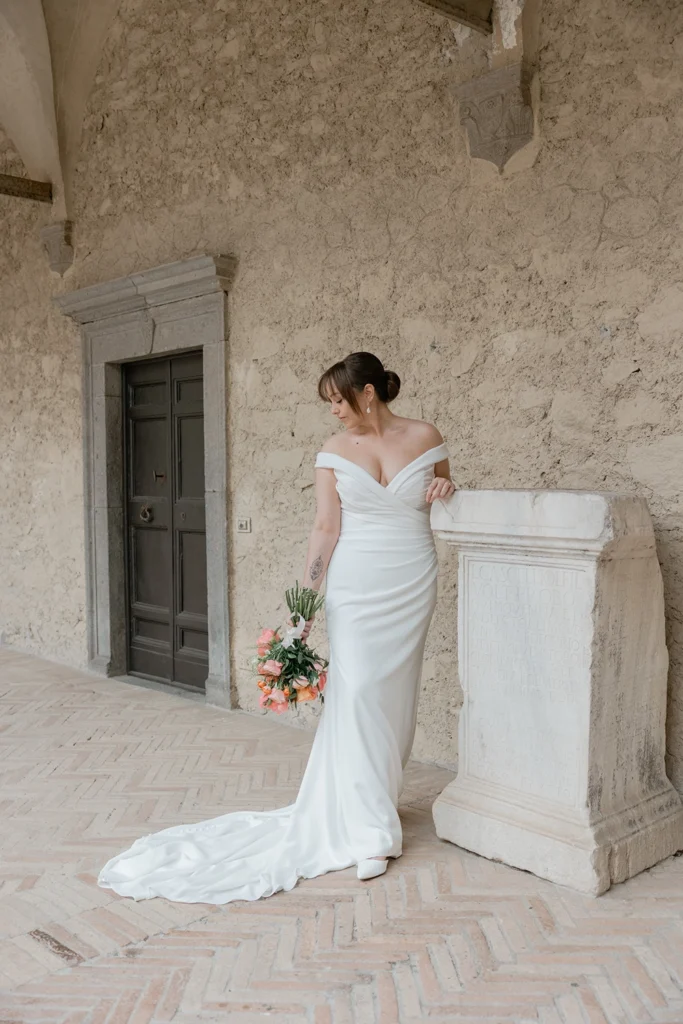
Perched 350 metres above the Amalfi Coast in Ravello, a village that Wagner, DH Lawrence, and Gore Vidal all chose as a retreat, Palazzo Avino is one of the finest small luxury hotels on the coast and one of the most photogenic wedding venues in southern Italy.
The elevation is everything. Unlike venues in Positano or Amalfi itself, which sit at sea level, Palazzo Avino looks down across the full arc of the coast — from the Faraglioni of Capri on clear days to the cliffs of Conca dei Marini below. The perspective is cinematic in a way that only elevation can produce.
The architecture, a 12th-century noble palace, pink-washed and covered in bougainvillea, provides a warmth of colour and texture that complements the blue of the sea below. Best season: September and October, when the tourist crowds thin and the light softens into something more personal.
Read more: My full guide to weddings at Palazzo Avino Ravello


5. Villa Cimbrone, Ravello (Amalfi Coast)
A ten-minute walk from Palazzo Avino through Ravello’s medieval lanes, Villa Cimbrone is the other great venue of the hilltop town, and its Terrazza dell’Infinito, the Terrace of Infinity, is one of the most photographed spots on the entire Amalfi Coast.
The terrace stretches along the cliff edge, lined with classical busts on stone plinths, and drops without warning into a 270-degree view of the Mediterranean 300 metres below. There is no equivalent view in Italy for couple photography. The composition virtually creates itself, couple in the foreground, infinity behind, the curve of the coast disappearing into haze.
The villa’s gardens, designed in the early 20th century by Lord Grimthorpe, an English aristocrat who bought and restored the medieval estate, include a rose garden, a Temple of Bacchus, a Gothic crypt, and a series of follies and pergolas that provide variety and shade throughout a long shooting day.
Best season: April and May for the gardens in full bloom. September and October for the clearest coastal light.
6. Le Filigare, Chianti (Barberino Val d’Elsa, Tuscany)
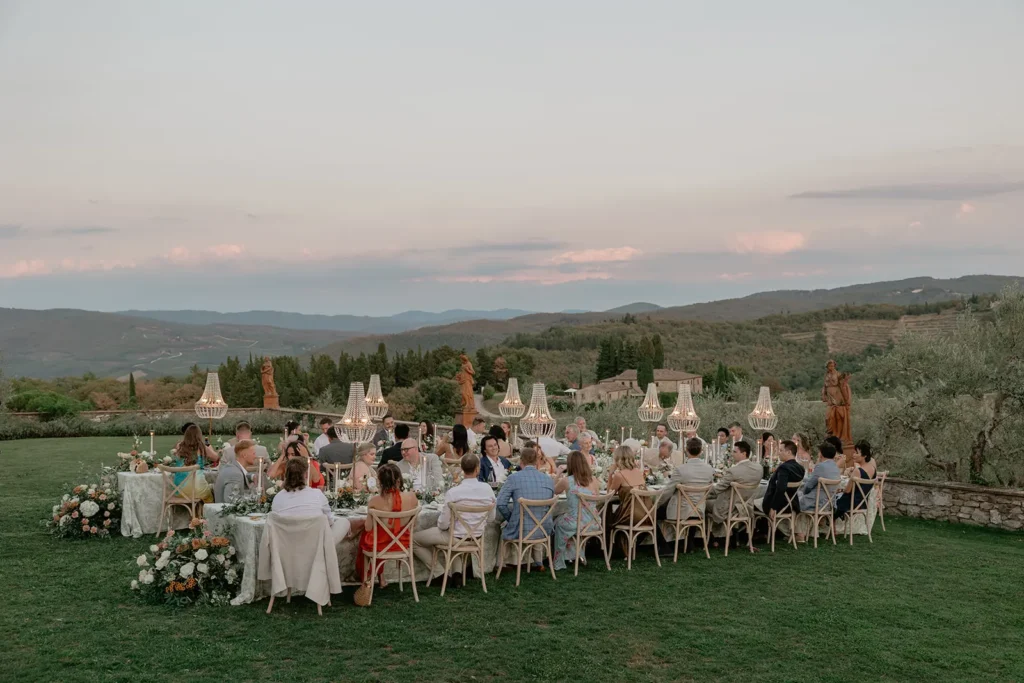
Le Filigare is a wine estate in the heart of Chianti Classico — between Florence and Siena — and it represents a kind of Tuscan wedding experience that larger, more famous venues can no longer offer: genuine agricultural scale, working vineyards in every direction, and a remoteness that makes the surrounding landscape feel entirely private.
The estate includes a restored farmhouse complex with ceremony and reception spaces, a pool with vineyard views, and accommodation for the wedding party. The vineyards in September, during the harvest, when the leaves are turning and the grapes are heavy on the vine, provide a backdrop that is both unmistakably Tuscan and deeply seasonal.
What I find most interesting photographically is the aerial perspective. Shot from the estate’s highest point, the vineyard geometry — the regular lines of vines converging toward the treeline, the farmhouse at the centre, creates a composition that rewards wide framing in a way that most villa venues don’t.
Best season: September without question. The vendemmia transforms the estate and the light simultaneously.
7. Borgo Santo Pietro, Tuscany (Chiusdino, Siena province)
In the hills south of Siena, between the Val d’Orcia and the Maremma, Borgo Santo Pietro is a 13th-century hamlet transformed into one of Tuscany’s most extraordinary small luxury hotels. The conversion, by a Danish couple who spent years restoring the original stone buildings and developing the surrounding land into biodynamic gardens and a working farm, has produced something that feels genuinely different from most Tuscan venues.
Photographically, the gardens are the story. The kitchen garden alone, with its espaliered fruit trees, raised beds, rose arches, and beehives, offers more visual variety than many venues achieve across their entire grounds. The light in this part of Tuscany, south of Siena, has a clarity and warmth that I associate with the best autumn shooting days anywhere in Italy.
Best season: May and September to October. The harvest period in late September adds an extraordinary atmosphere.
8. Castello di Vincigliata, Florence (Fiesole, Tuscany)
Ten minutes above Florence in the hills of Fiesole, Castello di Vincigliata is a medieval castle largely rebuilt in the 19th century by John Temple Leader, a British politician who fell in love with Tuscany. The result is a romantic interpretation of the medieval, more dramatically castle-like than most original castles, with battlements, towers, a drawbridge, and a courtyard designed for exactly the kind of photographic impact couples are looking for.
The views from the battlements take in the entire Florentine valley, the Duomo, the hills of Chianti, the cypress-lined ridges of Fiesole. On clear mornings in spring and autumn, there is a mist in the valley that gives the view an atmospheric depth that flat light can’t produce.
Ceremonies in the courtyard, with the stone walls rising on all four sides and a canopy of sky above, are among the most contained and dramatically framed spaces for wedding photography in Tuscany.
Best season: April, May, and October.
Planning a wedding at one of these venues?
If you’re considering any of these venues and want to understand what photography coverage would look like on the day, I’d be glad to talk through the specifics — light, timing, logistics, and what to prioritise given your venue and guest count. You can also browse my real weddings and portfolio to see how I work across different locations before reaching out.
→ Check my availability for your date
Written by Cristiana Fiorini, destination wedding photographer based in Italy, working across Italy.


