
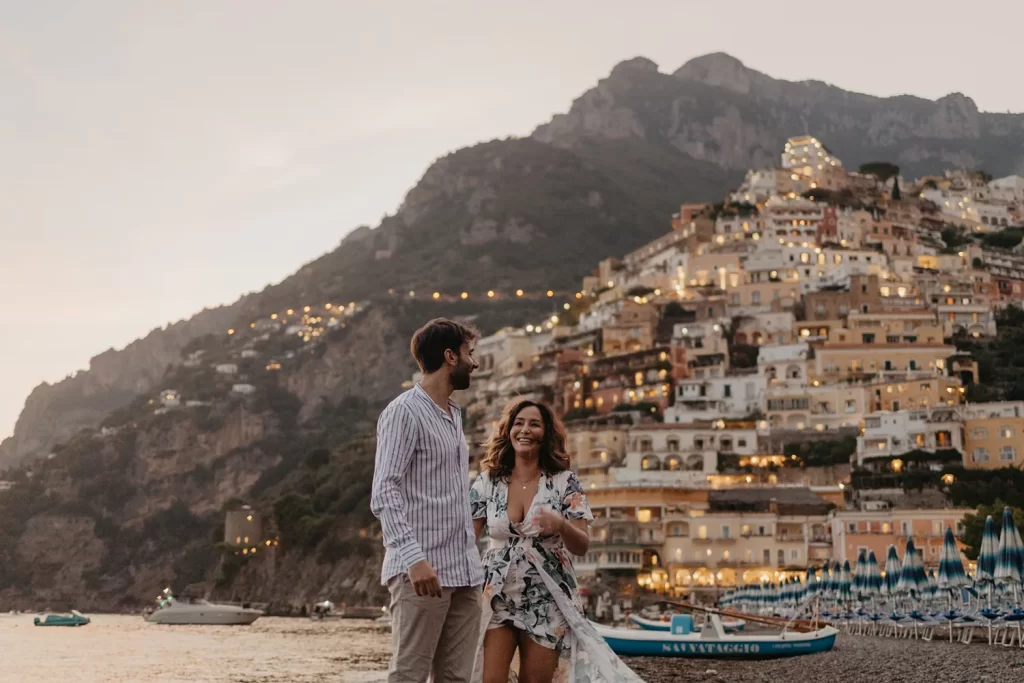
Positano is one of those places that arrives fully formed in the imagination before you ever see it in person. The pastel houses cascading down the cliff, the narrow staircases, the church dome, the boats in the bay, you have seen all of it before, in films, in magazines, in the social media feeds of everyone who has ever visited. And then you arrive, and it is still surprising. The photographs you have seen do not prepare you for the scale of it, or for the particular quality of the light on the water in the early morning, or for the way the whole town seems to tilt toward the sea.
I have photographed couples in Positano and along the Amalfi Coast, and what I have learned is that this is one of the most demanding locations I work in, and one of the most rewarding. The logistics are genuinely complex. The crowds are real. The midday light is brutal in summer. But when the conditions align, when you are on the right terrace at the right moment with the right light, Positano produces images that are unlike anything else in Italy.
This guide covers what I know about photographing in Positano; the light, the locations, the practical realities, and what couples should understand before choosing this extraordinary town as the backdrop for their wedding or engagement session. For a broader overview of the entire coastline, my complete guide to getting married on the Amalfi Coast covers everything from legal requirements to vendor logistics.
Positano as a Photography Location — What Makes It Different
Positano faces south-southwest across the Tyrrhenian Sea, which means the afternoon light hits the town from the side and above, creating strong shadows on the cliff face and warm direct light on the terraces and facades that face the water. The best light in Positano comes in two windows: the hour after sunrise, when the town is in soft side light and the sea is still calm, and the hour before sunset, when the whole cliff turns golden and the water goes deep blue.Outside these windows, particularly between eleven and four in the summer months, the light is overhead and harsh and the streets are at their most crowded.
The visual character of Positano is defined by its verticality. The town climbs the cliff in layers, and the relationship between the different levels, the terraces above, the beach below, the church dome in the middle is what gives Positano its distinctive composition. Understanding this verticality is essential for photography here. The most interesting images are not taken at sea level looking up, or from the water looking in, but from the mid-levels of the town looking across and down, where you can frame the layers of the architecture against the sea beyond.
Positano is also genuinely crowded for most of the year. In July and August the main beach and the central streets are shoulder-to-shoulder from nine in the morning until late evening. This is not a reason to avoid Positano, it is a reason to plan your photography carefully around the early morning and late evening windows, and to work with a photographer who knows which locations offer privacy and which are impossible to use in peak season.


The Best Locations in Positano for Wedding Photography
The Upper Town and the Terraces
The most beautiful photography locations in Positano are not the famous ones that appear in every travel magazine. They are the terraces and viewpoints in the upper part of the town, accessible by the steep staircases that most visitors never climb. From these elevated positions, the composition of Positano resolves itself, the church dome in the foreground, the coloured houses cascading below, the sea and the Faraglioni of Capri on the horizon. This is the view that makes Positano immediately recognisable, and it is available to anyone willing to climb for twenty minutes in the early morning before the heat sets in.
The gardens and terraces of the hotels in the upper town, particularly those facing south toward the sea, catch the morning light beautifully. Many of these spaces are accessible only to hotel guests, which is worth considering when choosing accommodation for your wedding or session.
The Church of Santa Maria Assunta
The church of Santa Maria Assunta, with its majolica-tiled dome, is the architectural centrepiece of Positano and the most immediately recognisable element of the town’s skyline. Civil ceremonies can be held in Positano’s town hall, and religious ceremonies in the church itself. The space around the church, particularly the steps leading down to the beach level, offers one of the most characteristically Positano compositions available; the dome above, the sea below, the coloured houses on either side.
The Beach and the Waterfront
Spiaggia Grande, Positano’s main beach, is most useful photographically at either end of the day. At sunrise the light comes from behind the cliff to the east and creates a soft, diffused illumination across the beach and the town above. At sunset the direct light catches the western faces of the buildings and turns the whole scene golden. During the day the beach is crowded and the overhead light is unflattering. For couple sessions on the beach, early morning before eight is the only time that works in summer. The smaller beach at Fornillo, a ten-minute walk west of the main beach, offers more privacy and a slightly different perspective on the town. It is worth considering for couples who want a quieter setting without leaving Positano entirely.


The Boat Perspective
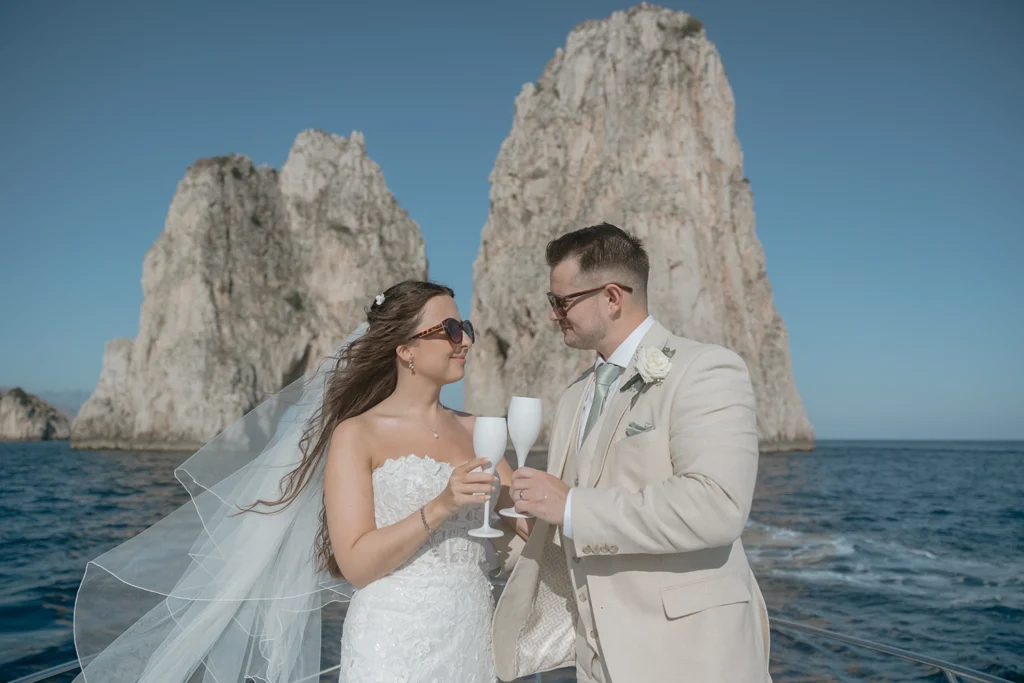
One of the most underused photography approaches in Positano is shooting from the water. A private boat session, moving along the coastline with Positano behind you, gives access to compositions that are impossible from land, the full cliff face, the relationship between the town and the sea, the scale of the landscape. I have done this during couple sessions and the images have a completely different quality from anything shot on land. For weddings that include a boat transfer between locations on the Amalfi Coast, building in time to photograph from the water is worth discussing with your photographer in advance.
The Amalfi Coast Beyond Positano
Positano is the most photographed town on the coast but it is not the only one worth considering. The stretch of coastline between Positano and Ravello offers a range of settings that complement each other well and that together tell a more complete story of the coast than any single location can.
Ravello, perched 350 metres above the sea on the ridge between Positano and Amalfi, offers a completely different visual character, elevated, serene, with panoramic views across the full arc of the coast. Villa Cimbrone’s Terrace of Infinity and Palazzo Avino are among the most photographically extraordinary venues on the entire coast, and the elevated position means the light here is different from anything at sea level. I have photographed weddings in Ravello and it is consistently one of the most rewarding locations I work in on the coast.
Praiano, the small town between Positano and Amalfi, is quieter and less visited than its neighbours and offers some of the most beautiful sunset light on the coast. The church of San Gennaro, perched on the cliff above the town with a view across to Positano, is one of those locations that very few couples know about and that produces extraordinary images in the right light.
For couples considering the full coastline, my guide to getting married on the Amalfi Coast covers venue options, legal requirements, and photography considerations across all the major towns.
Practical Advice for Planning Wedding Photography in Positano
The crowds. Positano receives approximately four million visitors a year concentrated into a town of four thousand residents and a road system designed for mules. In peak season, June, July and August, the main beach, the central streets, and the church steps are genuinely inaccessible for clean photography during the day. The solution is not to avoid Positano but to plan entirely around early morning and late evening, and to work with a photographer who knows which locations are usable at which times.
The logistics. Positano has no flat ground. Everything involves stairs, and the streets are too narrow for most vehicles. Getting equipment, people, and yourself between locations takes longer than it would anywhere else. Factor significantly more time between locations than you would in a flat city, and wear shoes you can actually walk in.
The ZTL restrictions. The Amalfi Coast road has strict vehicle access restrictions, particularly in summer. Vendors, photographers, and guests all need to navigate these. A local planner or photographer who works on the coast regularly will know the current restrictions and can advise on logistics. For an overview of what destination wedding photography on the Amalfi Coast involves practically, my guide to wedding photography packages in Italy covers travel logistics and what to expect from a photographer working in complex locations.

Season. May, June, September and October are the best months for photography in Positano. The light is beautiful, the crowds are manageable in the early morning, and the sea is warm enough for a coastal atmosphere without the peak summer intensity. July and August are extraordinary but demanding. November to March is quiet, cooler, and offers a completely different Positano; intimate, unhurried, and with a quality of winter light on the water that is genuinely beautiful for couples who are not attached to the classic summer aesthetic.
Frequently Asked Questions
What time should you photograph in Positano to avoid crowds?
Before eight in the morning in summer is the only window when the main beach and central streets are genuinely quiet. The town fills quickly after nine. For evening photography, the hour before sunset, typically between seven and eight in July and August, is when the light is most beautiful and the day-trip visitors have largely left. Planning your portrait session around these two windows gives you the best combination of light and privacy.
What are the best venues for weddings in Positano?
Civil ceremonies take place in Positano’s town hall, which has a terrace with a view of the bay. Religious ceremonies are held in the church of Santa Maria Assunta. For receptions, the hotels and private villas in the upper town offer the most extraordinary settings, elevated terraces with views across the entire coastline. Le Sirenuse and Il San Pietro di Positano are among the most celebrated properties on the coast and both offer extraordinary settings for wedding photography.
Is Positano better than Ravello for wedding photography?
They offer genuinely different things. Positano is immediately dramatic and visually iconic, the coloured houses, the beach, the dome. Ravello is elevated and serene, with panoramic views and a quality of light that is more consistent throughout the day. For couples who want the classic Amalfi Coast aesthetic, Positano is the obvious choice. For couples who want extraordinary views, more manageable logistics, and a slightly less tourist-heavy environment, Ravello is often the better answer photographically.


How far in advance should you book a photographer for a Positano wedding?
12 to 18 months for peak season dates. The Amalfi Coast is one of the most popular wedding destinations in Italy and the photographers with genuine local experience fill their calendars early. If you are considering a specific date in May, June, September or October, reaching out as early as possible is genuinely important.
Can you have an engagement shoot in Positano before your wedding?
Yes, and I actively encourage it. A pre-wedding session in Positano gives you time to experience the location before the wedding day, builds confidence in front of the camera, and produces images that are genuinely different from wedding day photographs. It is also the best way to identify which locations work best for your specific vision before committing to a wedding day timeline. My guide to pre-wedding photoshoots in Italy covers how to make the most of a session on the Amalfi Coast.
Planning a wedding in Positano?
Browse my portfolio and real weddings to see how I work along the Amalfi Coast, then reach out if what you see feels right.
Written by Cristiana Fiorini, destination wedding photographer based in Italy, working across Italy.


