
Planning a destination wedding in Italy often begins with images. You scroll through Instagram, Pinterest, and carefully curated blogs, and everything looks effortlessly beautiful, golden light, historic villas, quiet landscapes that seem almost unreal in their perfection. At that stage, choosing a photographer can feel like a purely visual decision, something guided by instinct and aesthetic preference.
But what many couples don’t immediately realise is that in Italy, beauty alone is not what defines a photograph. What truly matters is how that image comes into existence, and what happens before and around the moment it is captured. This guide is written to slow that process down — to replace noise with perspective, and to help you understand what you are really comparing when you scroll, save, and hesitate.
Read also: The essential guide to wedding photographer Florence Italy 2026

Why Italy makes the choice harder than it looks
Italy is not one place photographically, it is many. The golden hour in Chianti feels entirely different from the coastal light above Ravello or the diffused northern light on Lake Como. A photographer who works beautifully in one region may struggle in another, not because of skill, but because of familiarity.
Each region also brings its own logistical complexity. Historic venues in Tuscany often require FAI permits. Churches in Rome have strict rules about flash and movement during ceremonies. The Amalfi Coast requires timing around boat transfers, narrow roads, and the particular way midday light bounces off white stone. Venues in Venice involve water transport logistics that affect the entire shape of the day. A photographer who knows these dynamics doesn’t just react to them — they anticipate them.
This local knowledge extends to hidden locations as well. Some of the most beautiful images happen away from the obvious landmarks — in olive groves behind a Sienese farmhouse, in the service corridors of a Florentine palazzo during the preparations, in the narrow vicoli of Trastevere at dusk. A photographer who has spent years working in a region accumulates that knowledge slowly, through repetition and attention. It is not something that can be researched in advance of a single wedding.
According to Junebug Weddings, one of the most respected international wedding publications, Italy ranks consistently among the top three destination wedding countries worldwide. That popularity means the market is large and competitive — and the quality gap between photographers is significant. Knowing how to read that gap is what this guide is about.


What you are really comparing when you compare portfolios
A portfolio is not evidence of competence. It is evidence of choice. Every photographer decides what to include and what to leave out, what moments matter, what emotions are worth showing, what version of a wedding they believe in.
When you compare portfolios, you are not comparing sharpness, cameras, or lenses. You are comparing sensitivity, perspective, emotional distance, and narrative priorities. Some photographers focus on spectacle. Others on intimacy. Some are drawn to elegance and structure. Others to chaos and movement. None of these approaches are wrong, but only one will align with how you want to remember your wedding.
Instead of asking whether a portfolio is impressive, ask whether it feels honest. Ask whether the people in the images seem present rather than performing. Ask whether the moments breathe. Ask whether you can see yourself in those photographs, not just aesthetically, but emotionally. Those answers matter far more than visual perfection.
The most important thing you can request is a full gallery from a recent wedding, not just highlights. A highlight selection tells you what a photographer looks like at their best. A full gallery tells you what you will actually receive: how they handle the slow middle of the afternoon, the chaotic hour before the ceremony, the reception when the light has gone and the room is full of movement. Look for consistency across preparations, ceremony, portraits, and reception. Look for how they handle low light, indoor spaces, and the quieter moments between the major events. These are where the real differences between photographers appear.


What most couples get wrong
There are several recurring patterns that emerge when couples approach this decision.
The first is relying too heavily on Instagram. It presents only highlights rather than a complete narrative. The platform rewards visual impact over storytelling depth, which means the photographers who perform best on Instagram are not necessarily the photographers who perform best across an entire wedding day. A strong photographer should be evaluated on their ability to deliver consistency across ten hours, not on their best ten images.
The second is prioritising price over experience. Budgeting is an important part of planning, but photography is one of the few elements that remains long after the wedding is over. The flowers are gone by the next morning. The food is a memory. The images are what you return to for the rest of your life. It is worth considering not only how much a service costs, but what level of reliability, vision, and expertise it provides in return. For a detailed breakdown of what wedding photography in Italy typically costs, my Tuscany pricing guide covers the main variables clearly.
The third mistake is underestimating the importance of local and regional experience. Italy’s visual richness conceals real technical challenges — strong midday light in summer, rapidly changing weather on the coasts, the complex lighting of medieval interiors. A photographer familiar with your specific region will approach these with a confidence that no amount of general skill can replace. Ask for examples from your specific area, not just from Italy generally. A photographer who has worked repeatedly in your region is a fundamentally different proposition from one who has worked there once.
The fourth mistake, and one that is specific to destination weddings, is choosing a photographer based on a video call impression alone. The personality that comes across in a thirty-minute conversation is real, but it is not the full picture. Ask for references from couples who planned their wedding remotely, from abroad, across time zones. Those couples experienced the full arc of the process, from initial inquiry to gallery delivery, and their perspective is the most relevant reference you can find.
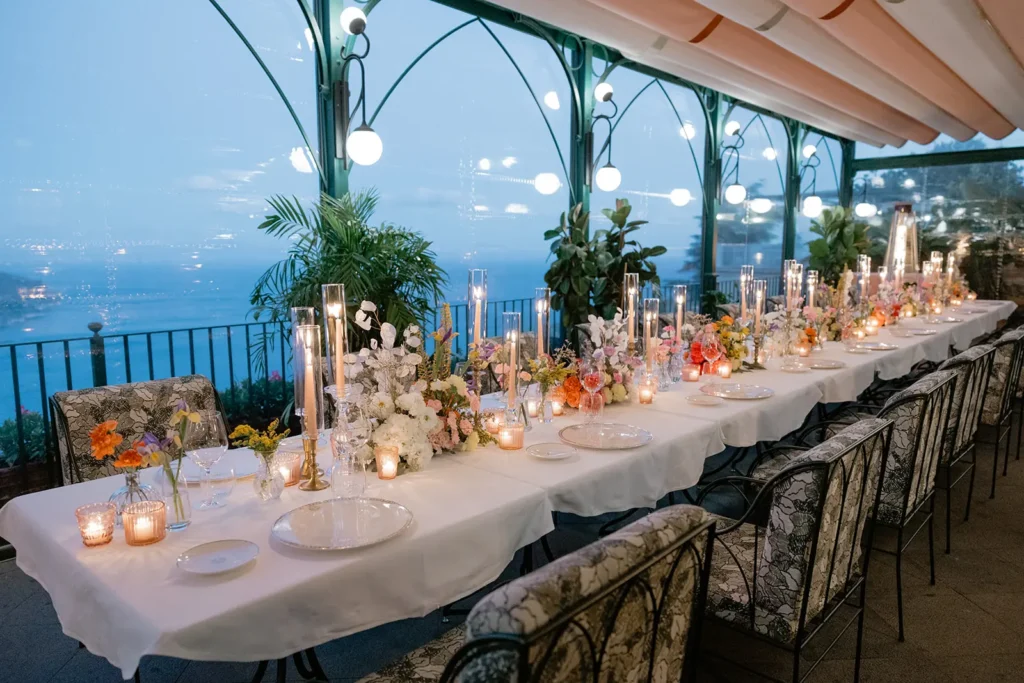
Documentary vs Editorial Wedding Photography: What’s Right for You?
Before narrowing your shortlist, it helps to understand the two main approaches to wedding photography in Italy, because they produce fundamentally different results and suit different kinds of couples.
Documentary photography, also called reportage, focuses on observing and capturing moments as they unfold naturally, with minimal direction. The photographer works quietly in the background, reading the room rather than shaping it. The results feel lived-in, emotionally immediate, and often surprising, moments you didn’t know were happening until you saw the photograph. This is my primary approach. I stay invisible until something is worth capturing, then I move in. Most of my couples tell me afterwards that they barely noticed I was there, which is exactly what I’m aiming for.
Editorial photography involves a more constructed approach, directing the couple, building compositions, and producing images that feel closer to a fashion shoot than a documentary. The results can be visually extraordinary, but they require dedicated time during the day and a couple who is comfortable being directed. If you feel self-conscious in front of a camera, an editorial approach can actually increase that discomfort rather than ease it.
Most experienced photographers work with a blend of both, documentary for the narrative flow of the day, editorial for the couple portraits. What matters is understanding which proportion feels right for you, and choosing a photographer whose natural instinct aligns with it. If you want to understand more about what a documentary approach looks like in practice, this piece on film photography in Italian weddings explains the specific qualities that analogue work adds to the final collection.


How to Evaluate a Wedding Photographer’s Portfolio (Beyond Instagram)
Evaluating a photographer’s work requires going beyond curated selections and looking at complete wedding stories.
Requesting full galleries is one of the most effective ways to understand how a photographer works across different moments of the day, from preparation to ceremony to evening reception. This allows you to assess not only the quality of individual images, but also the consistency of the overall narrative.
It is equally important to observe how the photographer handles more challenging situations, such as low-light environments during dinner, harsh sunlight during midday ceremonies, or fast-paced moments that leave little room for adjustment. These conditions reveal far more about a photographer’s ability than ideal scenarios.
Consistency should be the underlying criterion. A strong portfolio is not defined by a few exceptional images, but by a coherent standard maintained throughout the entire event.
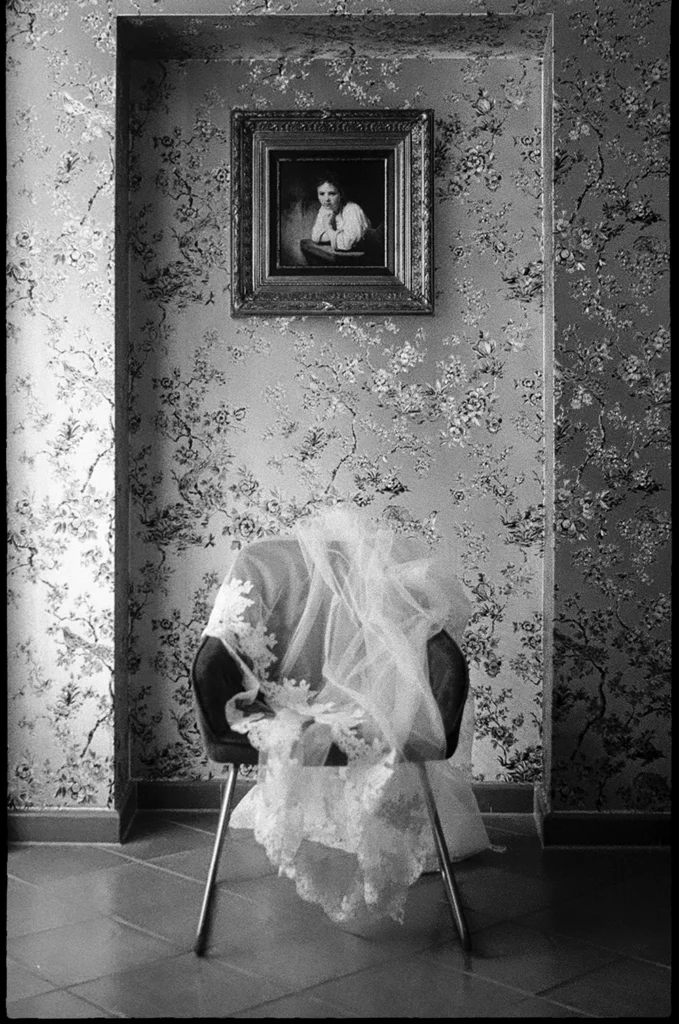

Where to find photographers worth comparing
The most reliable sources are editorial publications and curated directories, not search engines alone. Publications like Junebug Weddings, Rock My Wedding, and Bespoke Bride feature photographers whose work has been selected editorially rather than simply paid for or ranked by algorithm. The photographers published there have been reviewed against a consistent aesthetic standard.
Beyond publications, look for photographers who have been featured in real wedding stories at venues similar to yours. A photographer published shooting at a Tuscan vineyard, an Amalfi Coast villa, or a Roman palazzo has demonstrated their ability to work in that specific environment, which is as close to a venue-specific reference as you can get before booking.
Social media is a useful starting point, but treat it as exactly that, a starting point. What you see on Instagram is what the photographer chose to show you. What matters is the full gallery.
The thing that comparison can’t measure
Every practical consideration above matters. But there is something that checklists and reviews cannot fully capture and that is whether you trust this person. For couples planning a destination wedding in Italy from abroad, your photographer is the professional you will spend the most time with on the day itself. They will be present in your most private moments; preparations, vows, the quiet spaces between events. They will act independently in a country that may be unfamiliar to both of you, managing light, logistics, people, and emotion simultaneously, without a safety net.
A photographer who listens carefully, answers questions directly, and communicates consistently before you’ve signed anything is far more likely to do the same on the day. A photographer who is slow to respond, vague about logistics, or reluctant to share full galleries is telling you something important before you’ve spent a euro.
Trust your instinct on this. The technical skill is verifiable. The human fit is something you feel — and it matters more than almost anything else on a day when you are trusting someone with the memory of your wedding.
Read also: Getting married in Italy a complete guide for foreign couples
The practical checklist — what to verify before signing
Once you have a shortlist of photographers whose work resonates and whose communication feels right, the comparison becomes more concrete. These are the things worth verifying before you make a decision:
Experience in your specific region. Ask for examples from your area, not just from Italy generally. A photographer who has worked repeatedly at venues on the Amalfi Coast, in the Chianti hills, or at venues in Rome or Florence brings something that general skill cannot replicate.
Full wedding galleries from recent weddings. As discussed, always ask for these before deciding. At least one gallery from a wedding similar to yours in terms of venue type, season, and size.
What the contract covers. Make sure you understand: what happens if the photographer has an emergency on the day, what the cancellation and deposit terms are, how and when images are delivered, and whether travel is included or billed separately.
Communication across time zones. How quickly and clearly a photographer responds before you’ve committed is the most reliable indicator of how they will communicate throughout the process. If a photographer takes two weeks to respond to an initial inquiry, that pace will not improve after you’ve signed.
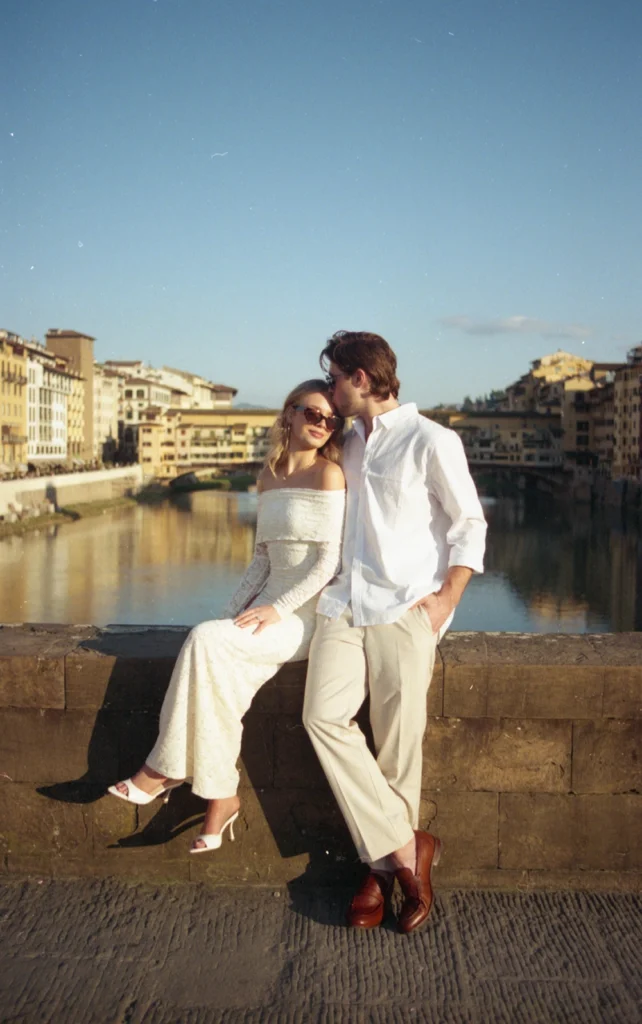
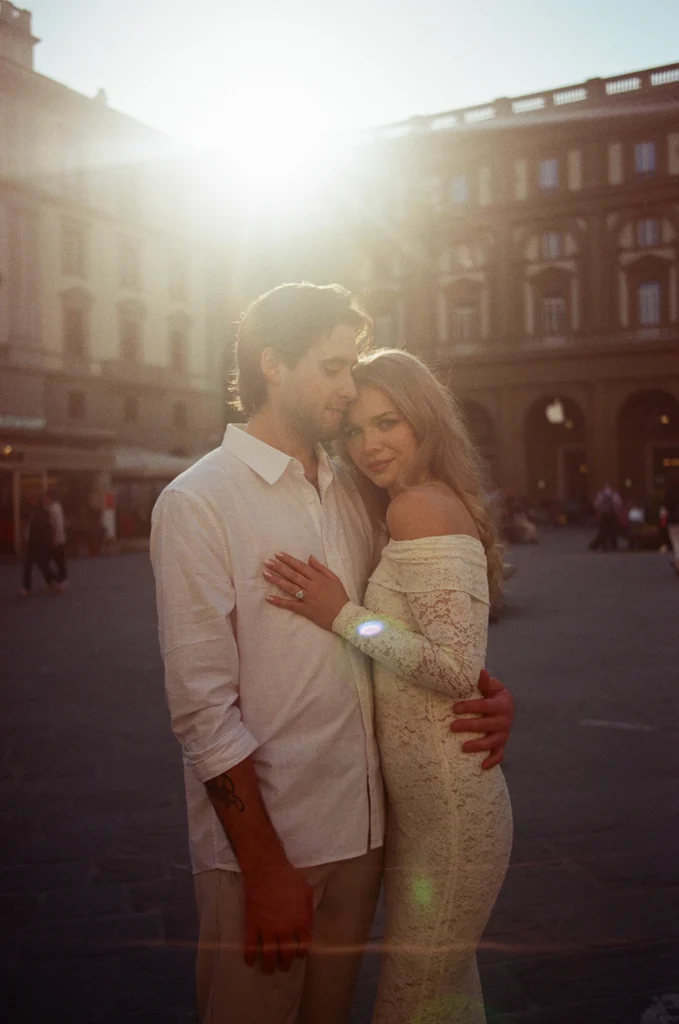
Film alongside digital. If a specific aesthetic matters to you, ask whether film is offered and what it adds to the cost. Film and digital produce fundamentally different results, film adds grain, warmth, and a quality of light that digital struggles to replicate in post-production.
A second photographer. For weddings over 60–70 guests, or when you want simultaneous coverage of separate preparations, a second photographer is worth considering. Ask whether this is included in the packages offered, available as an add-on, and who the second photographer is, their work should be consistent with the primary photographer’s style.
References from international couples. As mentioned, the experience of planning from abroad is genuinely different from a local booking. Ask specifically for references from couples who planned remotely.nderstand is not only what a photographer has done in the past, but how they think when things do not go exactly as planned.

When to start looking and why timing matters more than you think
The question of when to start the search is one that couples consistently underestimate. For destination weddings in Italy, the best photographers, at every price point, tend to be fully booked 12 to 18 months in advance for peak season dates. Peak season in Italy runs from late April through early October, with May, June, and September being the most competitive months.
Starting your search early is not about rushing a decision, it is about having genuine options. If you begin looking six months before your date, you will find photographers available, but they will be the ones who were not chosen by the couples who started earlier. That is not always a negative, but it does narrow the field significantly.
The practical timeline I would suggest: begin researching seriously 14 to 18 months before your wedding date. Create a shortlist of five to eight photographers whose work resonates. Request full galleries and quotes from all of them simultaneously, not sequentially. Have conversations, ask questions, and give yourself time to sit with the decision rather than rushing to fill a gap in your calendar.
Once you have decided, move quickly to confirm. A verbal commitment means nothing in this industry. Your date is held only by a signed contract and a deposit. Until both are in place, the date remains available to other couples.


How to read reviews and what they don’t tell you
Online reviews for wedding photographers are useful, but they require some interpretation. Most reviews are written immediately after the wedding, when the emotional experience of the day is still dominant. This means they tend to reflect how the couple felt about the photographer as a person, their warmth, their presence, their ability to put people at ease, more than a considered evaluation of the images themselves.
This is actually useful information. A photographer who consistently receives reviews about making people feel comfortable, working unobtrusively, and being easy to communicate with is demonstrating something real and important. The relational quality of the experience matters, for an engagement shoot, it shapes how natural the images feel; for a wedding day, it affects the mood of everyone around the photographer.
What reviews often don’t capture is the long-term experience of living with the images. The couples who are most satisfied tend to be those whose expectations were well-set before the wedding, who understood the photographer’s style, discussed what they wanted, and received what they expected. When you read reviews, look for evidence that the photographer communicated clearly, managed expectations honestly, and delivered consistently. Those patterns are more meaningful than the general sentiment.
One reliable signal: look for reviews that mention specific moments or images. A review that says “she captured the moment my father saw me in my dress for the first time, and I didn’t even know it was happening” tells you something concrete about how a photographer works. A review that says “amazing photographer, would recommend” tells you very little.

What Experience Looks Like in Practice
In many weddings I photograph in Tuscany, what initially appears effortless is often the result of small, carefully timed decisions. Light shifts quickly across open landscapes, and a location that feels perfect at one moment can become difficult just minutes later. Knowing when to move, when to wait, and when to let a moment unfold naturally is rarely visible from the outside, but it defines the difference between an image that simply looks beautiful and one that feels complete.
What I often notice working with international couples is a natural focus on the visual aspect of the day, the venue, the scenery, the atmosphere. All of this is important, but it can sometimes overshadow the experience itself. When couples feel at ease, when they are not constantly thinking about being photographed, something changes in the images. They become more honest, more grounded, and ultimately more lasting.
One thing that happens more often than expected is that the most meaningful photographs are not the ones that were planned in advance. They emerge in between moments, in transitions, in situations that cannot be fully controlled. Being able to recognize those moments, and to respond to them without interrupting their natural flow, is what experience gradually teaches. It is less about directing what happens, and more about understanding when to step forward and when to step back.

Final Thoughts
Choosing a wedding photographer in Italy is rarely a purely rational decision. At the beginning, it often feels like a visual process. You are drawn to certain images, certain atmospheres, certain interpretations of light and space. And this is a natural starting point. Aesthetic connection matters, because it reflects how you imagine your wedding to be seen.
However, as the planning process evolves, it becomes clear that photography is not only about how something looks, but about how it is experienced. A wedding day is fluid. It does not unfold exactly as planned, and it is precisely within these small deviations that the most meaningful moments tend to emerge. The role of a photographer, in this context, is not simply to document what is happening, but to understand how to move within that uncertainty without disrupting it.
This is why experience, sensitivity, and awareness often matter more than style alone. A strong portfolio can show you what is possible. But it is consistency, presence, and the ability to adapt that determine what will actually happen on your wedding day.
Taking the time to look beyond individual images, to ask thoughtful questions, and to understand how a photographer approaches real situations will give you a much clearer perspective. It will also allow you to make a decision that is not based on trends or immediate impressions, but on a deeper sense of alignment.
Because ultimately, what you are choosing is not only a service. You are choosing a way of seeing. And over time, that perspective becomes inseparable from your memory of the day itself.
If you’re planning a destination wedding in Italy and want a photographer who understands not only how it looks, but how it unfolds, I’d love to hear more about your plans.
Planning a destination wedding in Italy?
If you’d like to understand how I work before making any decision; my approach, full galleries from recent weddings, and what my packages include, I’m glad to share all of that without any obligation.
Browse my real weddings and portfolio first, then reach out if what you see feels right.
Written by Cristiana Fiorini, Italy-based destination wedding photographer


